
← Projects
Private platform · never public
Emulate the attack. Measure the defense.
GothamCity is my private adversary-emulation platform. It turns threat profiles and ATT&CK techniques into controlled campaigns, keeps execution context visible, and shows exactly where defensive coverage held—or where the operator still has a blind spot.
500ATT&CK techniques indexed
277Atomic mappings available
56LOLBAS-enriched techniques
Operator console
Coverage that explains itself.
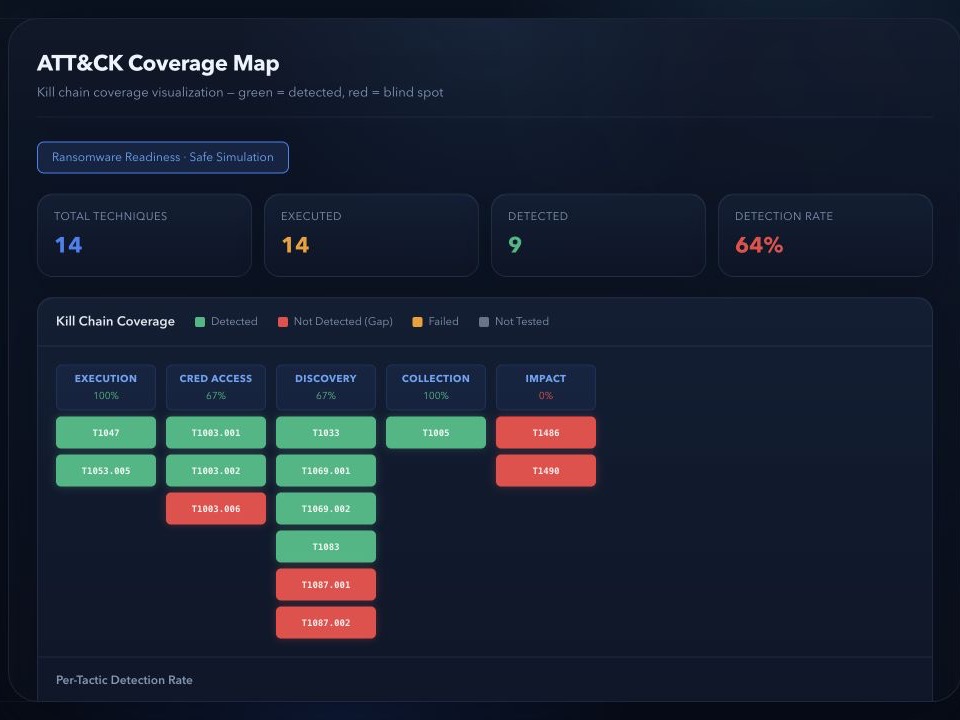
This synthetic preview mirrors a local, agent-free validation run. All fourteen techniques completed in simulation; nine were marked as detected, leaving five explicit gaps for review.
Kill-chain coverageDetection by tactic
completed simulationExecution100%
coveredCredential access67%
review remaining evidenceDiscovery67%
review remaining evidenceCollection100%
coveredImpact0%
detection gapVerified product surfaces
Real screens. Sanitized data.
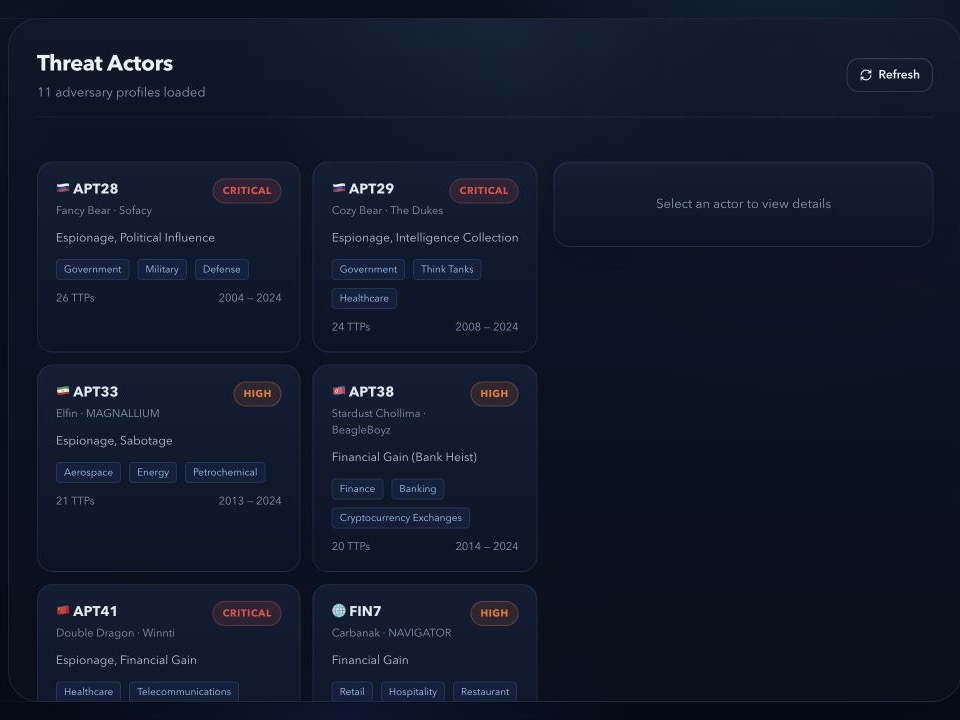
These images were captured from the local Docker build. The account area and environment details are excluded; the remaining content uses built-in threat profiles and a target-free simulation.
Campaign lifecycle
Plan, execute, challenge, repeat.
GothamCity keeps campaign composition and defensive interpretation in one loop, without pretending that a queued command and a verified endpoint execution are the same event.
Compose with context
Start from actor profiles or focused templates, then narrow the plan by platform, tactic, prerequisites, cleanup needs, and risk—not by a flat list of technique IDs.
Make execution honest
Staged, simulated, queued, dispatched, and agent-executed states stay distinct. The console shows the assigned agent and execution mode so a simulation never masquerades as endpoint proof.
Measure what defended
Results roll into tactic-level coverage, ATT&CK Navigator output, Sigma-oriented analysis, and a repeatable retest path. Undetected activity remains a named gap, not a buried log line.
Execution boundary
A control plane with visible limits.
The platform is designed for authorized labs and purple-team work. Its public page describes the decision model while operational components remain private.
GothamCity owns
- Threat-profile, template, and technique-based campaign planning
- Atomic Red Team and LOLBAS execution context with cleanup metadata
- Explicit simulated-versus-live agent state and campaign history
- Detection coverage, blind-spot review, reporting, and retest workflow
GothamCity does not claim
- A simulated result proves a command ran on a real endpoint
- An ATT&CK mapping alone proves detection quality or impact
- A registered agent authorizes activity outside an approved scope
- The private repository, deployment, or operator payloads are public