Series · 5 partsATM Security AssessmentPart 1 · You are here
- 1The ATM Was Locked Down. The Transaction Path Was Not.You are here
- 2The BIOS Had a Password. The Boot Chain Still Needed Trust.
- 3The Desktop Was Hidden. The Execution Boundary Was Not.
- 4The Device API Was Standard. Authorization Was Assumed.
- 5One ATM Was Contained. The Fleet Trust Path Was Not.
ATM security review in 60 seconds
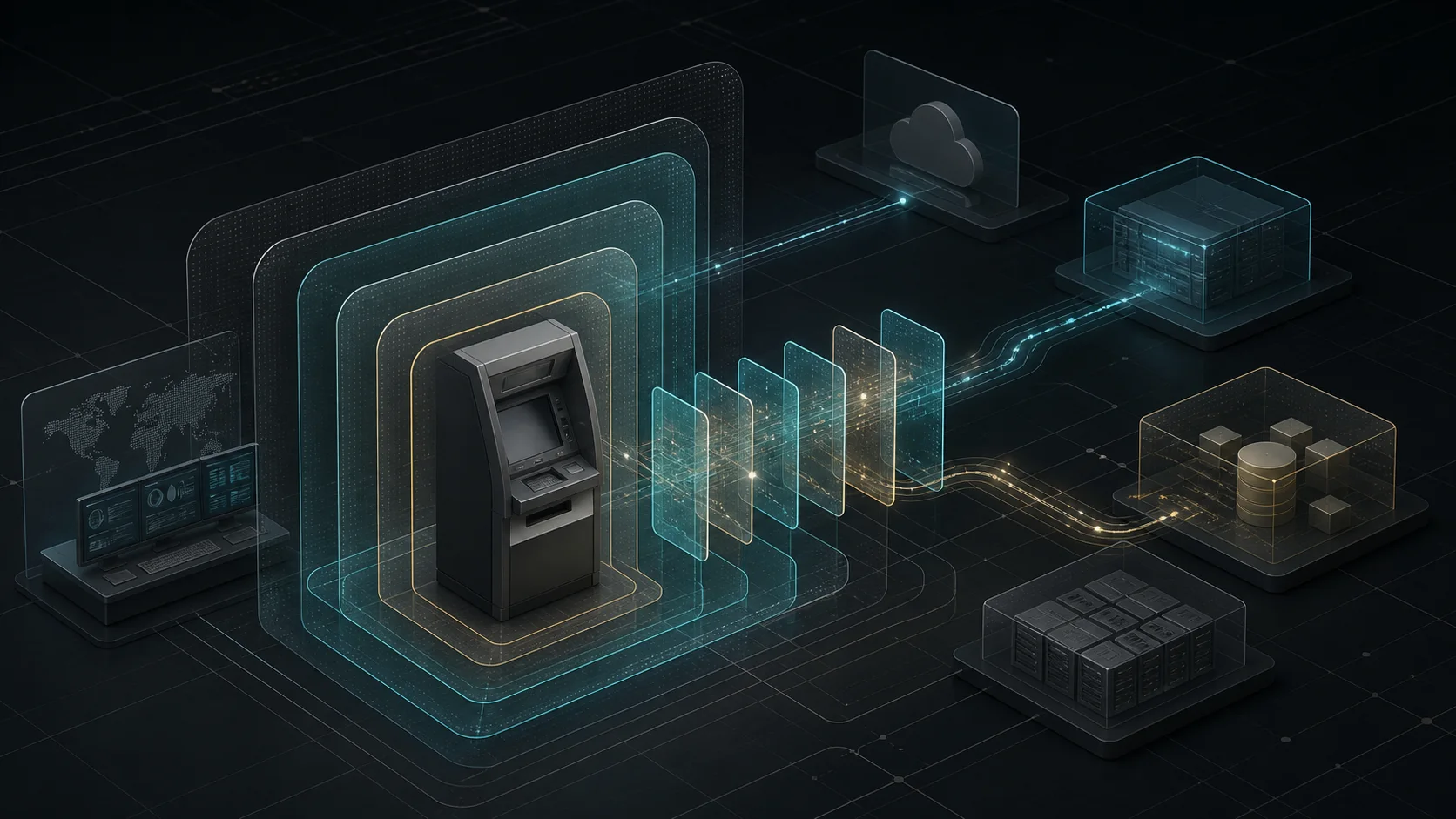
An ATM is not one computer in a steel box. It is a chain of trust decisions stretched across a public-facing kiosk, an operating system, device middleware, an encrypting PIN pad, several peripherals, remote-management services, monitoring infrastructure, and a transaction switch. The cabinet may be locked while the architecture still trusts the wrong process, the wrong network path, or the wrong maintenance identity.
That is why a useful ATM penetration test does not begin with “Can I make the machine dispense cash?” It begins with a safer and more defensible question:
Can any component cross a trust boundary without the identity, integrity, authorization, and telemetry that the business believes protect it?
This is a methodology note, not a claim about a specific production ATM estate. It describes how to structure an authorized assessment and how to collect evidence without exposing cardholder data, handling live PIN material, opening a path to uncontrolled cash movement, or turning a report into an operational attack manual.
The asset is the transaction, not the terminal
The visible machine is only the nearest endpoint. The protected assets include cash, account data, PIN confidentiality, transaction integrity, cryptographic keys, terminal availability, software integrity, and the operator’s ability to distinguish a fault from an attack.
A terminal can therefore pass a conventional hardening review and still fail the more important test. Full-disk encryption does not prove that an approved application is the only process able to request a sensitive device operation. A restricted desktop does not prove that a maintenance session is strongly authenticated. Network segmentation does not prove that the transaction switch receives trustworthy terminal identity. A tamper sensor does not prove that anybody is alerted when its state changes.
The assessment has to follow the transaction and ask where each assertion comes from:
- Who says this is an approved terminal?
- Who says this software image is intact?
- Who says this operator may enter maintenance mode?
- Who authorizes a peripheral operation?
- Who detects that the expected sequence changed?
- Which component fails closed when the answer is missing?
Phase zero: make the test safer than the vulnerability
The rules of engagement are part of the technical design. An ATM assessment needs more than a generic authorization letter because a normal test action can collide with cash reconciliation, fraud monitoring, card-network controls, branch safety procedures, or a real customer session.
Before touching a terminal, record:
- exact asset identifiers, location, ownership, vendor, software baseline, and permitted hours;
- whether the target is a lab unit, a decommissioned unit, or a production terminal;
- approved test cards, test accounts, transaction limits, and the responsible switch operator;
- prohibited actions, including live PIN collection, retention of account data, uncontrolled peripheral commands, destructive tamper tests, and denial-of-service activity;
- an emergency stop contact who can isolate the terminal and reconcile its state;
- evidence-handling rules that prohibit secrets and sensitive authentication data from entering screenshots, packet captures, shell history, tickets, or the final report.
Production should be used for observation and low-impact confirmation only. Any test that could change cash state, key state, firmware state, safety controls, or transaction availability belongs on a vendor-approved lab unit or simulator. If the organization cannot provide that environment, the gap is not permission to improvise. It is a testability finding.
Phase one: build an evidence-backed asset model
Start with inventory, not scanning. Compare the operator’s source of truth with what the terminal and management plane report. Capture versions and configuration states without collecting credentials or payment data.
The minimum model includes the terminal identifier, deployment class, operating-system support state, kiosk application, device-middleware family, approved service providers, peripheral firmware, encrypting PIN pad approval status, boot protections, application-control policy, remote-management path, logging destination, network segment, transaction endpoint, and named owners for each layer.
The first valuable result is often a disagreement. The inventory says the terminal is one build; the allowlisting console sees another. The branch team believes support access is brokered; the vendor believes a direct path still exists. The monitoring platform expects heartbeats from every terminal; a subset has been silent long enough to become normal.
Do not convert those disagreements straight into vulnerabilities. Turn them into hypotheses, then test which control depends on the stale assertion.
Phase two: test the local trust chain
The local review asks whether the terminal can reach a trustworthy state and stay there. That includes verified boot or an equivalent integrity mechanism, protected recovery paths, supported software, least-privileged services, application control, restricted local administration, protected secrets, secure update verification, and logs that survive loss of the endpoint.
The important distinction is between a control being configured and a control being authoritative.
An application-control policy is authoritative only if unauthorized execution is denied in every relevant operating state, including maintenance and recovery. A restricted desktop is meaningful only if alternate interaction paths do not expose a general-purpose environment. A patch baseline is defensible only if exceptions have owners and expiry dates. Local audit logs are evidence only if a compromised local administrator cannot silently rewrite the sole copy.
Use benign, organization-approved test artifacts and vendor test modes. Record the decision made by the control, the corresponding remote telemetry, and the recovery state after the test. The goal is not to run a payload. The goal is to prove whether unapproved state is prevented, detected, and recoverable.
Phase three: treat middleware as a policy boundary
Financial-service middleware exists to let applications interact with specialised peripherals through standardised interfaces. CEN describes XFS as a multi-vendor software interface to financial peripheral devices. That interoperability is operationally useful, but it also makes the middleware boundary security-critical: the application should not inherit sensitive device capability merely because it can reach a broker or service provider.
The review should establish:
- which process identities may request each class of device operation;
- whether authorization is enforced centrally or assumed from local execution context;
- whether service-provider binaries and configuration are integrity-protected;
- whether sensitive operations require transaction state, policy state, or a second authority;
- whether unexpected operation order, caller identity, or rate is logged remotely;
- whether the system fails closed when the middleware, peripheral, or upstream authorization path loses trustworthy state.
This is where the engagement must resist the temptation to produce spectacle. A video of cash moving is weaker evidence than a correlation showing that an unapproved caller reached a privileged device boundary and that the policy engine either denied or failed to deny it. The first is dramatic. The second identifies the broken control and gives engineering a regression test.
Phase four: separate PIN security from general host security
The encrypting PIN pad is not just another USB peripheral. PIN confidentiality and cryptographic key management belong to a separate assurance domain. PCI PIN Security addresses secure PIN processing and cryptographic-key lifecycle management, while PCI PTS POI defines security requirements for devices that protect PINs and account data at the point of interaction.
A general pentest should verify boundaries around that domain, not attempt to become a key ceremony or a destructive hardware evaluation. Confirm the approved device identity and lifecycle state; validate that inventory, tamper status, replacement, and retirement are controlled; verify that host logs and support workflows do not expose sensitive authentication data; and route any formal PIN or device-compliance question to the qualified program and assessor responsible for it.
The safe negative control is architectural: demonstrate that the host cannot obtain plaintext PIN material and that unsupported or unexpected device state produces a denial, an alert, or both. Never collect a real PIN to prove that a control should exist.
Phase five: test remote planes as separate attack surfaces
Many terminal reviews stop at the local operating system. That misses the systems with the largest blast radius: patch distribution, remote support, software deployment, secrets delivery, inventory, monitoring, and transaction routing.
For the service plane, test whether privileged access is strongly authenticated, attributable to one operator, time-bounded, approved, recorded, and restricted to the intended terminal group. Check whether a compromise of a vendor account, management relay, or deployment package would be contained by independent controls. Do not assume that a signed package makes the distribution path trustworthy; verify who can approve, publish, target, roll back, and audit it.
For the network plane, verify segmentation with allowlisted flows and terminal identity rather than subnet folklore. A diagram is not evidence that management, monitoring, name resolution, time synchronisation, and transaction traffic are constrained as intended. Test expected paths, then use safe negative controls to confirm that undeclared destinations and cross-terminal paths are denied and visible.
For the transaction plane, focus on integrity and state binding. Establish where terminal identity is authenticated, where messages gain integrity protection, how replays and duplicates are handled, how timeouts reconcile, and whether business authorization is independent of local device capability. Protocol-specific active testing should use the acquirer’s certification environment and synthetic accounts, not live cardholder traffic.
Phase six: make detection part of every test case
A terminal control that blocks an action but produces no useful telemetry solves only half the problem. An alert that fires without enough context to identify the terminal, caller, policy, and result solves even less.
Every validation should have two linked assertions:
- What did the prevention control decide?
- What did the remote operator learn, and how quickly?
Correlate terminal time, management time, and monitoring time. Verify that reboots, recovery-mode entry, policy changes, service starts, integrity failures, peripheral-state changes, remote sessions, and transaction anomalies reach a system the terminal cannot rewrite. Then test the response path: acknowledgement, isolation, escalation, recovery, and reconciliation.
This turns “we have EDR on the ATM” into an answerable question. Did the control identify the terminal? Did it preserve useful evidence? Could the operator contain one machine without disrupting the estate? Could the terminal return to a known-good image without losing the audit trail?
Evidence matrix
| Signal | What it proves | Safe negative control | Defender verification |
|---|---|---|---|
| Inventory, terminal, and management records disagree on build or ownership | A security decision depends on stale or ambiguous asset truth | Reconcile one known test terminal across every source before expanding scope | Alert on unknown builds, duplicate identities, silent terminals, and ownerless exceptions |
| Benign unapproved state is blocked but no remote event appears | Prevention exists, but investigation and estate-wide response are blind | Use a pre-approved inert artifact and confirm both denial and off-host telemetry | Correlate terminal ID, caller, policy, hash, result, and trusted time |
| A maintenance identity reaches more terminals or functions than its approved task requires | Remote support is a high-blast-radius trust path | Use a scoped test role and request one explicitly forbidden function | Enforce per-terminal groups, just-in-time elevation, approval, recording, and expiry |
| A device capability is reachable without the expected application or transaction state | Middleware connectivity is being treated as authorization | Use emulator or vendor test mode to request a harmless state transition from an unapproved context | Bind caller identity, device operation, business state, policy decision, and alert in one trace |
| An undeclared network destination is reachable or a denied path is not logged | Segmentation policy and observed enforcement diverge | Attempt a low-impact connection to an organization-controlled sink outside the allowlist | Compare approved flow inventory with firewall, DNS, proxy, and terminal telemetry |
| A tamper, reboot, integrity, or peripheral-state event remains local | The terminal can lose trust without the control plane knowing | Trigger only a vendor-approved non-destructive test event | Verify off-host delivery, severity, runbook ownership, containment, and reconciliation |
| Transaction test state is accepted without the expected terminal, sequence, or integrity assertion | Business authorization trusts incomplete context | Use only synthetic accounts in the certification environment and require rejection | Validate terminal identity, integrity, freshness, duplicate handling, and reconciliation logs |
What a finding should look like
“ATM is vulnerable” is not a finding. “Outdated operating system” is rarely enough either. A report should identify the trust boundary, the unsupported assumption, the evidence, the safe negative control, the impact, and the narrowest control change that prevents recurrence.
A useful finding reads like this:
The remote-support role assigned to the test operator could initiate a privileged maintenance session on terminals outside the approved branch group. The management platform recorded a successful session but did not require branch approval or generate the expected security alert. No payment data, PIN material, peripheral command, or customer session was accessed. This makes compromise of one support identity an estate-wide control-plane risk. Restrict the role by terminal group, require time-bound approval, forward session events to independent monitoring, and regression-test a denied out-of-group session.
That statement tells engineering what failed and tells risk owners why it matters. It also records what the assessor deliberately did not do.
What I would not call proof
- A screenshot of an old version without evidence that the component is reachable or security- relevant.
- A scanner severity copied into the report without a terminal-specific trust path.
- A cabinet photo presented as proof of logical compromise.
- A local log entry with no trusted time or off-host correlation.
- A successful lab action presented as if it occurred in production.
- A compliance gap presented as an exploitable vulnerability without a demonstrated control consequence.
- Cash movement, PIN capture, or customer-data access performed only to make the finding look more serious.
The strongest writeup is often the one that stops earlier because its evidence is better.
The defender’s priority order
First, establish trustworthy inventory and ownership. You cannot secure an estate whose terminal identities, builds, locations, and support responsibilities disagree.
Second, constrain the service plane. Remote administration and software distribution can turn one identity or package into an estate-wide event. Strong authentication is necessary, but so are scoping, approval, integrity, independent logging, and rollback controls.
Third, make local integrity authoritative. Supported software, verified boot, application control, least privilege, protected recovery, and off-host telemetry have to cover maintenance states as well as the normal kiosk path.
Fourth, bind device capability to business authorization. Middleware should mediate operations with explicit caller, policy, and transaction context. Connectivity to a peripheral must never be treated as permission to use it.
Fifth, rehearse containment and reconciliation. A safe response needs a way to isolate one terminal, preserve evidence, restore a known-good state, and reconcile business state without creating a wider outage.
Closing thought
The ATM can be bolted down, encrypted, patched, monitored, and still rely on an untested assertion somewhere outside the cabinet. That assertion may live in a support role, a deployment pipeline, a middleware policy, a network rule, a terminal identity, or a transaction sequence.
The job of the pentest is not to create the most dramatic effect. It is to locate the first trust transition the architecture cannot justify, prove the control decision with the least dangerous method available, and leave the defender with a regression test.
The terminal is only where the transaction becomes visible. The security boundary is everywhere the transaction is trusted.
Public sources and standards context
- PCI Security Standards Council — Standards overview
- PCI Security Standards Council — PIN Security
- PCI Security Standards Council — PCI DSS v4.0.1 document library
- CEN-CENELEC — CEN Workshop on eXtensions for Financial Services (XFS)
- NIST SP 800-115 — Technical Guide to Information Security Testing and Assessment
PCI ATM guidance is an information supplement, not a replacement for the applicable PCI standards or for a qualified PIN/PTS assessment. Standards applicability, test authority, and production safety must be confirmed with the acquiring institution, operator, vendors, and the organization’s compliance owners before an engagement begins.
How current is this note?
The latest source-review, content-update, or publication date is shown.
Primary public records were checked. Environment-specific behavior remains outside the claim unless separately reproduced.